



Why are some casters designed with two wheels? A dual-wheel configuration involves more than just adding an extra wheel.
Time:Nov 05,2026
Why are some casters designed with two wheels? A dual-wheel configuration isn’t just about adding an extra wheel.
a wheel
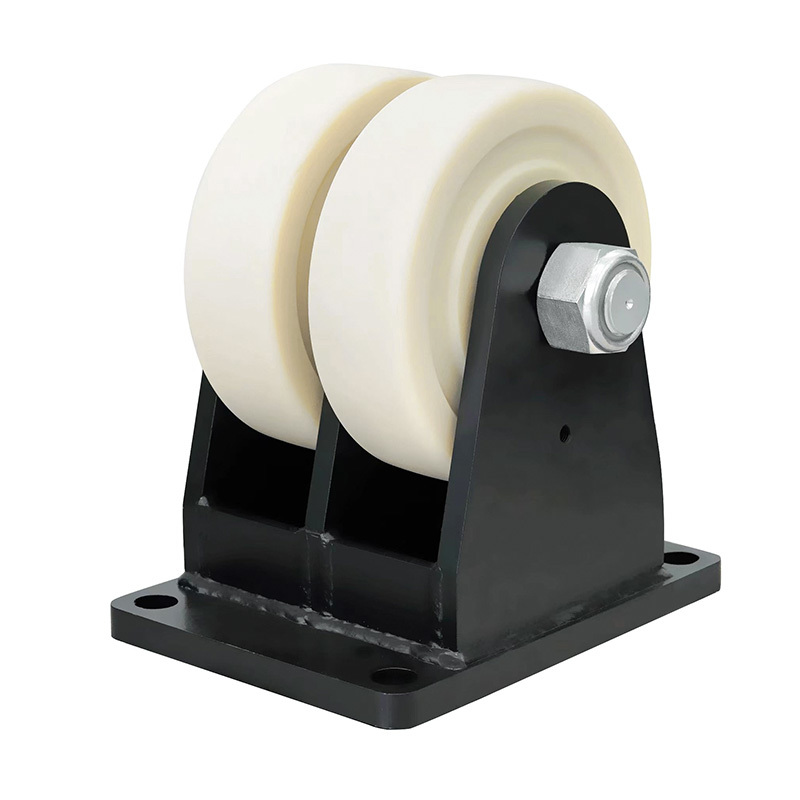
Among caster products, in addition to the common single-wheel design, there is a rather special type—the double-wheel caster.
From its appearance, it looks like two wheels are mounted on the same bracket. Some might assume that adding an extra wheel would naturally double its load-bearing capacity.
But the reality is not that simple.
The design value of dual-wheel casters lies not merely in increasing the number of wheels, but in using structural configuration to meet specific equipment requirements for load capacity, steering, and installation space.
So, what exactly are the characteristics of a dual-wheel structure, and what should you keep in mind when making a purchase?
1. What is the difference between a double-wheel caster and a standard single-wheel caster?
A standard single-wheel caster typically consists of a wheel body, a wheel axle, and a bracket.
Double-wheel casters feature two side-by-side wheels mounted on the same bracket structure, with both wheel bodies sharing the load and rolling motion.
This structure is used in some industrial equipment, mobile worktables, and specialized handling devices.
It should be noted that a twin caster is not simply two standard casters joined together.
The fit between its bracket, axle, steering mechanism, and wheel body must all be designed as an integrated whole.
II. Do two wheels necessarily double the load-bearing capacity?
This is a common misconception in selecting two-wheel casters.
In theory, increasing the number of wheels can help distribute the load, but the overall load-carrying capacity of a caster does not depend solely on the number of wheel bodies.
The strength of the support structure, the axle configuration, the wheel material, the contact conditions, and the overall load distribution all influence the final performance.
Moreover, in actual operation, the two wheels do not necessarily share the load evenly at all times.
If the ground has local irregularities, or if there are manufacturing tolerances in the wheel assemblies, the load distribution between the two wheels may change.
Therefore, the rated load capacity of a dual-wheel caster must be determined based on the overall wheel design and corresponding test results, and should not be simply calculated by doubling the load rating of a single-wheel caster.
III. Why might a two-wheel design be advantageous for steering?
For some twin-wheel swivel casters, the two wheels can exhibit different rolling behaviors during steering.
When the structure allows, this helps accommodate the difference in motion between the inner and outer wheels during a turn.
However, the specific steering performance still depends on the track width, wheel structure, ground friction conditions, and the steering mechanism.
Not all two-wheel casters are necessarily easier to steer than single-wheel casters.
When procuring equipment, validation should be based on its actual operating procedures rather than relying solely on visual inspection to assess flexibility.
IV. Why are some devices better suited to a two-wheel configuration?

For some devices with limited installation space at the bottom, designers may wish to achieve the required motion performance within a constrained structural height and installation footprint.
At this point, twin-wheel casters can be considered as an alternative.
However, the two-wheel configuration also occupies a certain amount of lateral space and increases the number of components.
Therefore, whether to adopt a dual-wheel configuration requires considering the equipment’s undercarriage clearance, overall structural design, operating environment, and maintenance requirements.
The dual-wheel design is not a comprehensive upgrade over the single-wheel version; rather, it offers an alternative structural option tailored to specific needs.
5. The space between the two wheels should not be overlooked.
There is usually a gap between the two wheels of a double-wheel caster.
Although this location is not conspicuous, it deserves attention during selection and maintenance.
If the equipment operates continuously in an environment containing debris, fibers, or other foreign materials, it is necessary to consider whether the inter-wheel area can easily accumulate contaminants and whether subsequent cleaning will be convenient.
For equipment with stringent cleaning requirements, it is also necessary to assess whether a dual-wheel design increases cleaning complexity.
Therefore, a compact structure does not necessarily mean that maintenance will be simple.
6. How should twin-wheel casters be practically tested?
For equipment intended to use a dual-wheel structure, it is recommended to first complete a trial assembly of samples and then conduct operational verification under actual operating conditions.
In addition to verifying the load-bearing capacity and basic functionality of the entire wheel assembly, it is also necessary to observe the contact between the two wheel bodies, the steering process, and whether there is any structural interference at the bottom of the equipment.
If the device needs to change direction frequently, steering performance should be a key verification item.
If the equipment is primarily subjected to heavy loads, particular attention must be paid to the load-bearing performance of its overall structure.
For special operating conditions, the corresponding test content should also be determined based on the actual risks.
7. When making a purchase, don’t just compare the prices of single-wheel and dual-wheel options.
Double-wheel casters typically involve more components and a different structural design, so their purchase price may differ from that of standard single-wheel casters.
However, when assessing whether a caster solution is reasonable, one should not consider only the price of an individual product.
More importantly, does it meet the equipment’s actual requirements, is it easy to install and maintain, and has it been thoroughly validated?
If a standard single-wheel caster already meets the requirements, there is no need to switch to a double-wheel design simply to achieve a more complex structure.
Conversely, if a two‑wheel configuration better meets the equipment’s design requirements, it should not be ruled out simply because it involves a greater number of components.
In conclusion
The structural design of casters has never been a simple matter of adding more units.
A single wheel has its own characteristics, and a dual-wheel setup also offers distinct practical benefits.
What truly matters about double-wheel casters is not that “there’s an extra wheel,” but how the two wheels work together with the bracket, axle, and steering mechanism.
For equipment manufacturers, the decision between single- and dual-wheel configurations should ultimately be based on actual operating conditions and the overall machine design requirements.
Previous article

Sweep the attention
Universal Caster
FOSHAN Globe Caster Co., Ltd.
Telephone: 86-757-86692299
Mobile:86-137 0966 5707
E-mail:sales@globe-castor.com
Fax: 86-757-86690681
Website:www.globe-castor.com
Address: 599 Yangxi Avenue, Yanghe Town, Gaoming District, Foshan City, Guangdong Province, China
Copyright©2024 FOSHAN Globe Caster Co., Ltd. All Rights Reserved