



What are the effects of lateral forces on industrial casters? Heavy-duty caster selection and lateral impact analysis | GLOBE Casters
Time:Nov 27,2026
In applications such as industrial transfer carts, machinery, and logistics handling platforms, purchasers typically focus on the rated load capacity, wheel material, and mounting dimensions of industrial casters, but often overlook another important factor: Lateral force 。
Casters not only bear the weight of the equipment but may also be subjected to lateral forces during turning, side pushing, equipment collisions, and special handling operations.
If the actual loading conditions on the equipment do not match the caster’s design, even if the caster’s rated load capacity meets the requirements, issues such as abnormal stress on the bracket, damage to connection points, or impaired rotation may still occur.
So, how does lateral force arise in industrial casters? And what factors should be considered when selecting heavy-duty industrial casters?
01|What is lateral loading on industrial casters?
Industrial casters typically bear loads primarily in the vertical direction, with the equipment’s weight transmitted through the mounting structure to the caster.
Lateral force refers to the transverse force exerted on a caster during use.
For example, a lateral load may be generated when the equipment is suddenly subjected to a side thrust while moving forward, or when it is forcibly pushed laterally before the wheel assembly has been aligned in the intended direction.
It should be noted that lateral force is not equivalent to the equipment’s weight. The two act in different directions and have distinct effects on the caster bracket, axle, and mounting/connection points.
Therefore, one cannot directly determine the magnitude of lateral forces a caster can withstand solely from its rated load capacity.
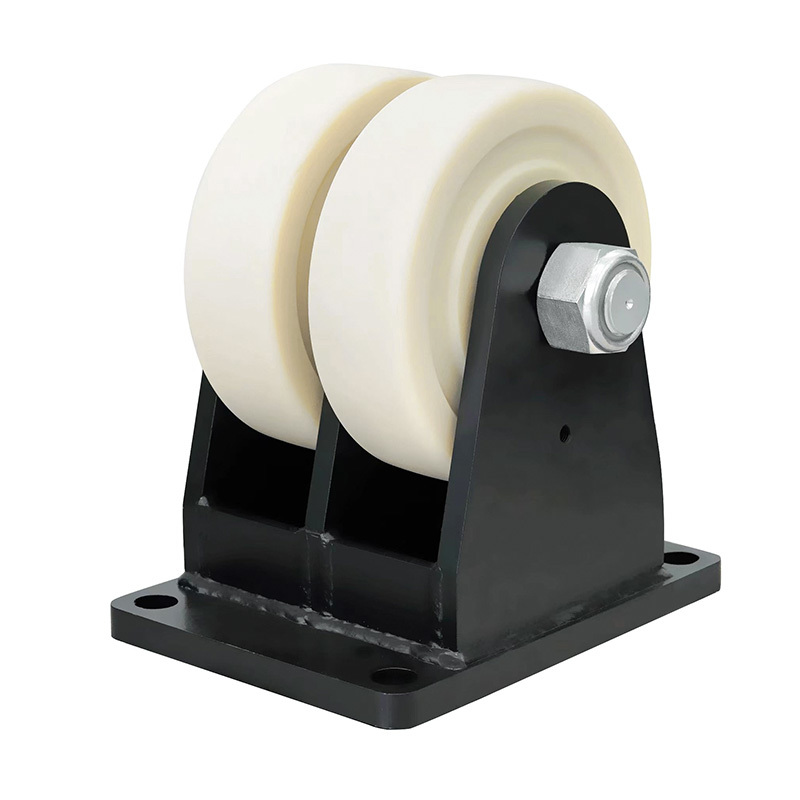

02|Which industrial equipment is more likely to generate lateral loads?
① Large industrial transfer cart
Large pallet trucks may experience significant lateral forces when turning or repositioning in workshop aisles.
If the operator pushes from the side of the equipment while the wheel orientation has not yet been adjusted, the caster may be subjected to additional lateral forces.
② Heavy machinery mobile platform
Heavy machinery and equipment are generally quite heavy; during movement, any change in direction or localized impact can transmit forces to the caster assembly.
In addition to the load-bearing parameters of heavy-duty industrial casters, such equipment should also take into account the actual operating conditions.
③ Automated logistics support equipment
Some automated equipment features repeated start–stop, steering, and positioning motions.
Under these operating conditions, casters may be continuously subjected to forces from different directions, necessitating a structural assessment that takes into account the overall machine’s motion.
03 | Which areas might be affected by lateral forces?
Support structure: When lateral forces are significant, the support structure may experience additional bending or torsional stresses. The actual impact depends on the material, geometry, and location of the applied load.
Axles and Connection Points: Lateral forces can alter the stress state of the connection structure, and special attention should be paid to the fit between the axle and the bracket.
Universal steering structure: For industrial swivel casters, lateral loads can affect the force distribution during steering. Under improper operating conditions, steering difficulties or increased localized structural stress may occur.
Equipment installation connection point: The lateral forces acting on casters can also be transmitted to the equipment’s base, so the overall machine connection structure should likewise be included in the assessment.
These phenomena do not mean that all lateral forces will cause damage; rather, they serve as a reminder to procurement and equipment design personnel to pay close attention to actual operating conditions.
04 | Why can’t lateral forces be ignored even when the rated load is within acceptable limits?
In industrial caster product data, the rated load typically refers to the load-bearing capacity determined under specified conditions.
However, during actual equipment operation, vertical loads, lateral forces, and other dynamic actions may act simultaneously.
After forces from different directions are superimposed, the stress state of the caster’s local structure may change.
Therefore, for equipment that requires frequent steering, lateral adjustments, or is subjected to special mechanical stresses, selection cannot be based solely on the rated load.
A more reasonable approach is to make a comprehensive assessment based on the equipment’s structure, mode of movement, and actual load conditions.
05|When selecting industrial casters, how do you evaluate lateral loads?
For equipment subjected to significant lateral forces, it is recommended to verify the following information in particular:
Mode of movement: Does the equipment primarily operate in a straight line, or does it require frequent turns and lateral adjustments?
Operation method: Should we use manual pushing, mechanical traction, or automated drive?
Equipment Structure: Are the caster mounting locations, the equipment’s center of gravity, and the chassis structure appropriately designed?
Abnormal operating conditions: Is a side collision, sudden change in direction, or forced lateral movement possible?
Verification requirements: Is it necessary to evaluate the load-bearing performance of casters and the overall machine connection structure through sample testing?
For specialized equipment, you can provide the caster supplier with information on the actual operating conditions to confirm whether the product is suitable for the intended application.
If there are stringent lateral load requirements, the relevant verification methods and acceptance criteria should also be clearly defined, rather than relying solely on product appearance or material thickness.
06|How to reduce unnecessary lateral impacts?
During the equipment design phase, casters should be strategically positioned and oriented to prevent them from being subjected to adverse stress conditions over extended periods.
During operation, move the equipment as closely as possible in accordance with its intended operating method, and avoid forcibly pushing it laterally when the wheel’s direction of movement is restricted.
For equipment subject to frequent collisions or lateral impacts, the operating route, equipment structure, and related protective measures should also be inspected.
If the casters show obvious deformation, abnormal rotation, or damaged connections, immediately stop any related operations and have them inspected.
Conclusion | When selecting industrial casters, the focus should shift from single-wheel load capacity to whole-machine force analysis.
Industrial casters not only support the weight of equipment but must also withstand various forces encountered during actual movement.
For heavy-duty pallet trucks, mobile platforms, and automated assistive devices, lateral forces are a key factor to consider during selection.
A truly sound industrial caster solution does more than simply meet rated load requirements; it must also be compatible with the equipment’s mode of motion and structural stress distribution.
If you are looking for Heavy-duty industrial casters, industrial swivel casters, polyurethane casters, or equipment-matched casters , welcome to visit GLOBE Universal Casters Official Website , learn more about the product.
Lateral Load on Industrial Casters,Industrial casters,Heavy-duty industrial casters,Lateral force on casters,Lateral Impact on Heavy-Duty Casters,Force Analysis of Industrial Omni-directional Casters,Lateral force on the caster bracket,Industrial Equipment Caster Selection
Previous article
Previous article

Why is lateral load consideration important for industrial casters? This article analyzes the force characteristics of heavy-duty industrial casters during cornering, lateral pushing, and equipment collisions, discusses the impact of lateral loads on caster housings, axles, and connecting structures, and outlines key considerations for selecting casters for industrial equipment.
Nov 27,2026
How to inspect industrial casters upon arrival? 6 quality check guidelines | GLOBE Casters Copy
What items should be inspected upon receipt of industrial casters? This article outlines six key steps in caster acceptance testing—verifying specifications, inspecting the wheel body’s appearance, checking the frame, conducting rotation tests, performing random dimensional checks, and documenting acceptance—to help companies standardize quality management for caster procurement.
Nov 26,2026
What causes industrial casters to slip? This article analyzes the traction performance of polyurethane, rubber, and nylon casters, discusses common causes of drive wheel spin and caster body slippage, and outlines key considerations for selecting casters for industrial equipment.
Nov 25,2026
Should industrial equipment use fixed casters or swivel casters? This article outlines the structural differences between fixed and swivel casters, common combination configurations, and key considerations for equipment layout, helping industrial equipment manufacturers select appropriate caster arrangements.
Nov 24,2026
How to choose between conductive and insulating casters? This article analyzes the differences in electrical performance, applicable equipment, material characteristics, and purchasing considerations for casters, helping electronics manufacturing and electrical equipment companies make informed caster selections.
Nov 23,2026
Sweep the attention
Universal Caster
FOSHAN Globe Caster Co., Ltd.
Telephone: 86-757-86692299
Mobile:86-137 0966 5707
E-mail:sales@globe-castor.com
Fax: 86-757-86690681
Website:www.globe-castor.com
Address: 599 Yangxi Avenue, Yanghe Town, Gaoming District, Foshan City, Guangdong Province, China
Copyright©2024 FOSHAN Globe Caster Co., Ltd. All Rights Reserved